


Local Knowledge. Shore Results.
House hacking can work at the Shore, but ADU and rental rules change from town to town and even block to block. The realistic goal is a payment you can sustain, not living for free.
You've probably seen the pitch. Buy a property, rent part of it out, let the tenants cover the mortgage, and live for free. It makes a great thumbnail. On the Jersey Shore the numbers rarely work out that cleanly, and the strategy looks different here than it does in an inland suburb.
For the right property in the right town, income from part of a home can make ownership work when it otherwise wouldn't. At the Shore that income can come from an ADU, a second unit, family sharing the house, or a summer season of rentals. Each one comes with local rules you need to check before you count on a dollar of it.
Here is what works, and what to check before you build it into an offer. This post is general education, not lending, tax, or legal advice, and the full note is at the bottom.
What House Hacking Means
The idea is simple. You buy a home you will live in and use income from part of it to offset what it costs to own. The execution has real range, and how much depends on the town you're looking at.
The version that went viral promised to eliminate your housing payment. That rarely happens. The better goal is a payment you can sustain. Say a rental unit brings in $1,600 a month against a $3,800 mortgage payment. Your net cost is $2,200. That might fit your budget when the full $3,800 would not, and that access is the real value.
The Ways Buyers Do This Here
Accessory Dwelling Units
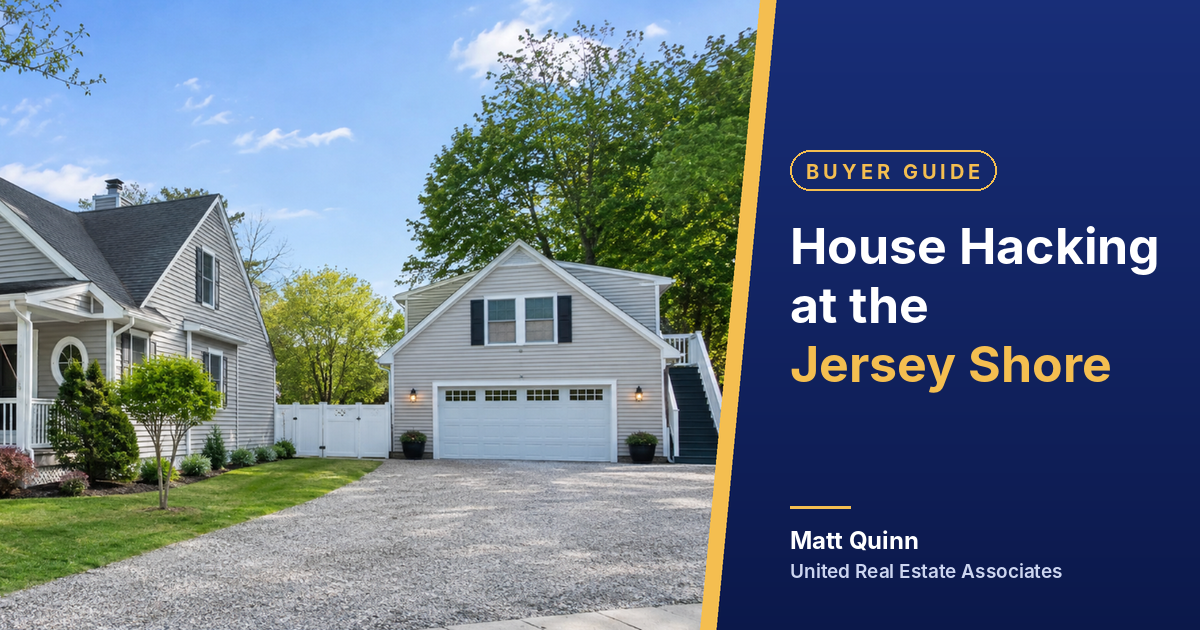
An ADU is a separate living space on the property: a detached backyard unit, a converted garage, or a basement with its own entrance. Financing has started to catch up with them. Fannie Mae now lets lenders count rental income from one ADU toward qualifying on the purchase of a one-unit primary residence, up to 30% of your total qualifying income. The change took effect with Fannie Mae's Desktop Underwriter update in March 2026.
Lenders still have their own documentation requirements, so ask a loan officer how they would treat the income on your purchase. Whether the unit is legal and permitted is a separate question, and it's a local one.
ADU legality is a zoning question, and it changes from town to town and sometimes block to block. With my zoning certification, I'd tell you not to assume anything based on a neighboring town's rules, or even a neighboring lot. Confirm with the township that an ADU is permitted on the specific parcel before you count that income in your offer.
Multigenerational Living
House hacking doesn't always mean a stranger paying rent. For many buyers it means sharing a home and its costs with family. In NAR's 2026 generational trends report, 19% of Gen X buyers bought a multigenerational home, the highest share of any generation. The top reasons were adult children moving back home and caring for aging parents.
That fits several towns in this market. Colts Neck, Wall, Marlboro, and Howell have larger lots and more bedrooms than a compact shore cottage, which suits a multigenerational household better.
If this is your plan, a larger inland home usually fits better than a barrier-island property. Keep that in mind before you fall for a beach block address that cannot hold the whole household.
The Classic Multi-Family
Buying a duplex, triplex, or small multi-family, living in one unit, and renting the others is the original house hack. It works best in towns with established multi-family housing. Asbury Park, Long Branch, and Belmar have older multi-unit homes as part of their housing history, which sets them apart from towns that are almost entirely single-family.
FHA loans can finance up to four units with as little as 3.5% down, as long as you meet the credit requirements and live in one of the units. Three- and four-unit homes also have to pass an FHA self-sufficiency test based on the rent the property can bring in.
Eligible veterans may be able to buy a two- to four-unit home with a VA loan and no down payment, depending on entitlement, income, and the lender. Freddie Mac's Home Possible program allows 5% down on two- to four-unit homes, with income limits and landlord education required.
Seasonal Rental
Most general house hacking content skips this one, because it's specific to the Shore. A property here doesn't need a year-round tenant to produce income. Renting part of the home, or all of it, for the summer season can offset a good share of your annual carrying costs.
There is a catch. Short-term rental rules are set by each town, not by the county, so there is no single Monmouth County or Ocean County answer.
Marlboro, for example, makes it unlawful to rent a residential property for fewer than 30 consecutive days, while other shore towns treat seasonal rentals as a normal part of the local economy. Don't assume your plan works because a neighboring town allows it. Confirm the rules for the exact town before rental income becomes part of your numbers.
The Real Math
Covering the entire mortgage with rental income from day one usually takes unusually favorable conditions or a large down payment. Buyers who run conservative numbers, budget for vacancy and maintenance, and stay patient tend to do well. Buyers who plan around best-case projections tend to struggle, especially here, where seasonal vacancy is a predictable part of the math.
The goal is a payment you can sustain, whether or not it ever reaches zero.
Set realistic expectations without writing the strategy off. Used well, it can put a home within reach that wouldn't otherwise fit your budget.
Who This Fits
Buyers moving up who want help carrying a bigger home. A property with an ADU, a second unit, or seasonal rental potential can close the gap between the home you want and the payment you're comfortable with.
Multigenerational households, including Gen X buyers supporting aging parents and adult children at the same time. A larger inland home usually does more for you than a smaller shore cottage.
Buyers who want to try investing. Living in the property while you manage a rental unit, long-term or seasonal, is a lower-risk way to learn the mechanics before you buy a standalone investment property.
What to Check Before You Commit
Zoning and local rules come first. ADU legality, short-term rental permissions, and multi-family zoning vary block to block here, not just town to town. What's allowed three streets away may not be allowed on the property you're considering. An unpermitted unit creates liability that outlasts whatever it saved you.
Run conservative numbers, especially around seasonal vacancy. Budget for the off-season, not just peak summer rates, and use realistic comparable rents instead of best-case listings you've seen online.
Be honest about what sharing a property involves, whether that's a tenant in an ADU or family under one roof. It takes a certain temperament. Buyers who start with clear boundaries tend to do well, and buyers who underestimate the personal side often struggle.
The Bottom Line
House hacking at the Jersey Shore works differently than it does in an inland suburb. Seasonal demand and a patchwork of local rental rules make this market its own thing. The fundamentals still hold: real equity, a payment you can sustain, and a path to ownership that might not otherwise work. The key is knowing which version of the strategy fits the town you're looking at.
Every town in this market handles zoning, ADUs, and rental rules differently. If you're wondering whether house hacking fits your situation, that conversation is worth having before you write an offer. Send me a message or call (609) 709-2742.
Matthew Quinn, United Real Estate Associates
(609) 709-2742
matt@mattquinnsellshomes.com
A note on this post: it covers zoning, accessory dwelling units, financing programs, rental income, and municipal rental rules at a general, educational level. It is not financial, lending, tax, or legal advice, and it is not an official determination for any specific property, loan, or municipality. Loan program guidelines, down payment requirements, and income rules change and vary by lender, so confirm current details with a licensed mortgage professional. Zoning, ADU legality, and short-term rental rules are set by each municipality, so confirm with the township before assuming what is permitted on a specific property. Rental income can carry tax implications, so talk with a qualified tax professional. I am a real estate agent with a zoning officer certification, not a licensed mortgage broker, tax advisor, or attorney.
Sources
- Fannie Mae ADU rental income update, effective March 21, 2026, via Pennymac Correspondent Announcement 26-29
- National Association of Realtors, 2026 Home Buyers and Sellers Generational Trends Report
- National Association of Realtors, Economists' Outlook on Gen X homebuyers
- Freddie Mac, Home Possible Mortgage Fact Sheet
- Township of Marlboro Code, short-term rental prohibition